
SAFERPAY
It all begins with wanting to make a difference
What’s the problem?
-
✺
Australians reported a record number of scams in 2023, with losses totalling $2.7 billion
-
✺
$208m was lost by Westpac Customers
to scams in 2023 -
✺
Losses were up by 25% to previous years, the most common from investment scams

GUIDING PRINCIPLES
Three principles anchored every decision:
Lead with empathy - every touchpoint was crafted to reduce anxiety, not amplify it.
Intervene at the right moment - the prompt only surfaces when high-risk signals are detected.
Precision over frequency.
Radical simplicity — complex fraud logic happens invisibly in the background. The user never sees it.
UNDERSTANDING THE PROBLEM
The goal was clear: protect customers from scams without adding unnecessary friction to everyday payments.
I partnered with fraud specialists and customer support teams to map the full payment journey, understanding where customers were most vulnerable and where they were most receptive to intervention.
This reframed the core design challenge: not whether to intervene, but when and how to create just enough friction to prompt reflection without undermining

DISCOVERY
I ran sessions with Risk and Technology teams to understand our fraud indicators and assess feasibility within our existing payments infrastructure.
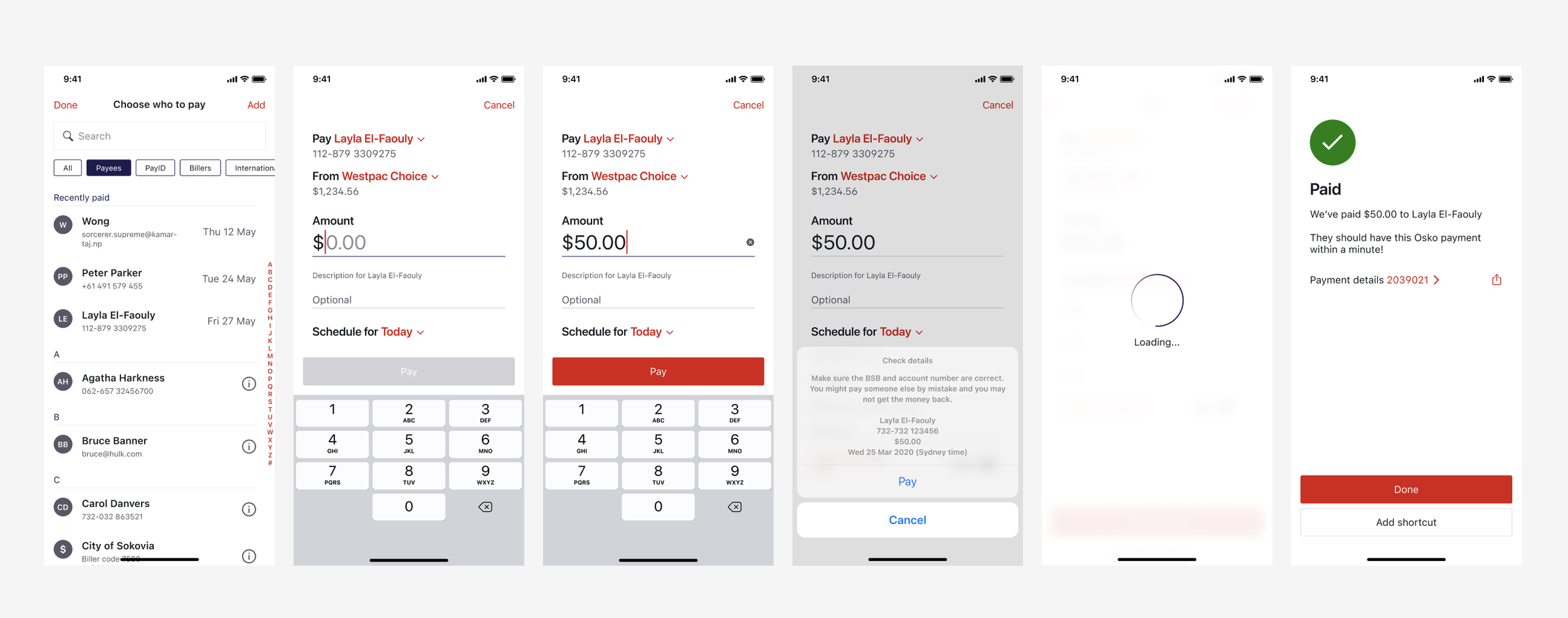
From there I mapped the end-to-end payment flow in Figma, which surfaced critical integration constraints early and became the foundation for user journeys and flow diagrams — keeping engineering and design aligned from the start.
HIGH FIDELITY DESIGN
After multiple iterations refining friction placement and visual hierarchy, I moved into high fidelity using the Westpac component library, ensuring pattern consistency and accelerating development handoff.
Two design decisions were non-negotiable:
Context continuity - the modal treatment kept users anchored in their payment flow. They never felt lost.
Language precision - copy was reviewed extensively to strip jargon and honour the simplicity principle. In scam detection, a single poorly chosen word can cause a customer to dismiss a genuine warning.
The final output was a fully interactive prototype covering all interaction states, outcome flows and animations - used to demonstrate exact customer journeys to senior stakeholders.

THE PITCH
We presented SaferPay to senior stakeholders with the prototype as the centrepiece.
The result: $40M in funding approved.
going to market
SaferPay launched to the Westpac mobile app in June 2024 and we went to market before the final build was complete. That was a first for Westpac, and a signal of how much confidence leadership had in the solution.
At launch, CEO Peter King described SaferPay as "the first innovation of its kind in Australia."
From there I worked across Marketing, Legal, Compliance and Technology to get SaferPay over the line, one of the most cross-functional projects of my career.
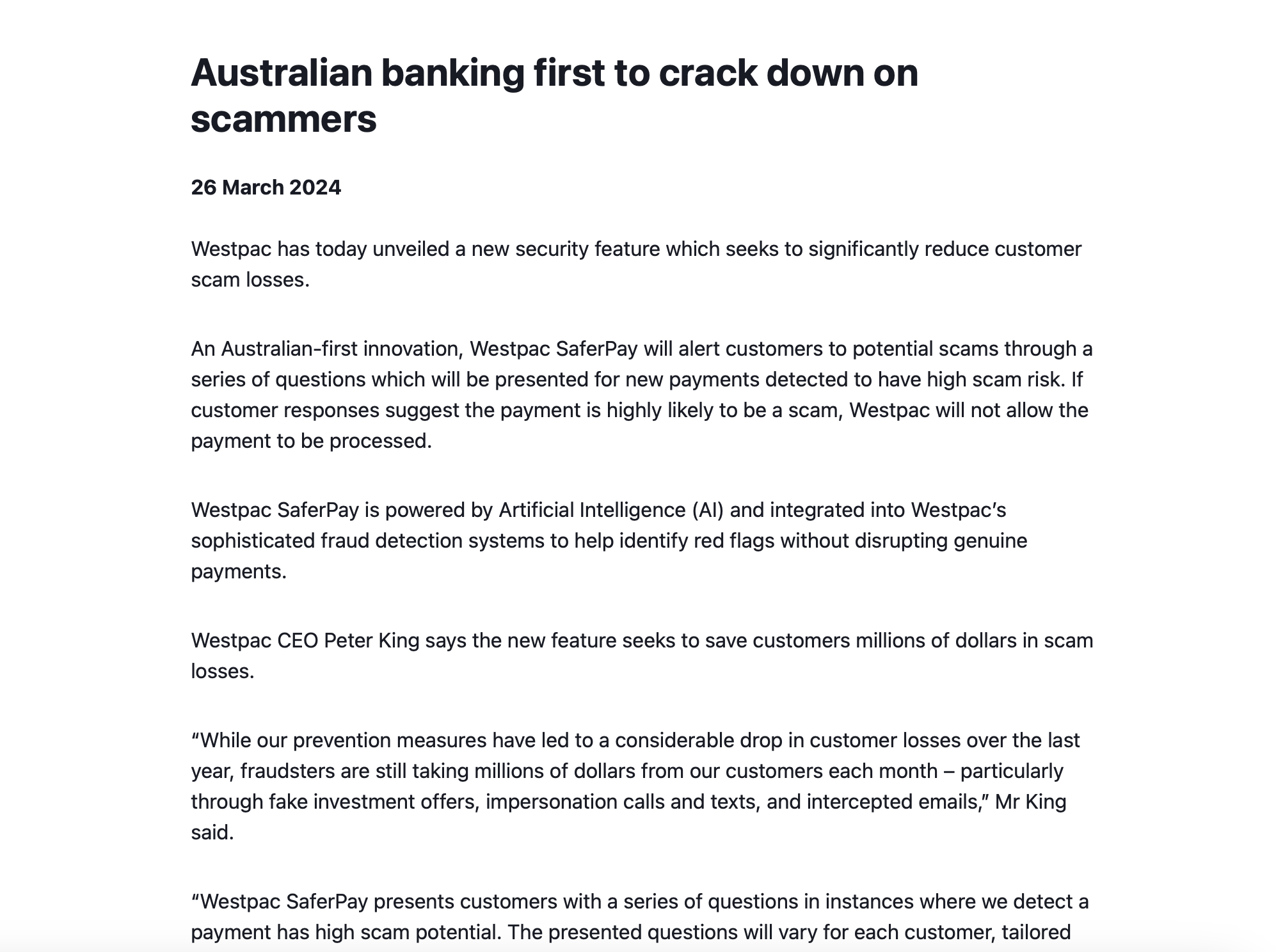
What have we been up to since launch you ask?!
in THE FIRST 4 months we have
AVERTED
$8 million
IN CUSTOMER LOSSES
HaD
109,000
saferpay
challenges
protected
1700
customers
prevented
250
mistaken
payments daily
REFLECTION
Saferpay was a defining project, one that pushed me to grow as both a designer and a design leader.
Taking ownership of the end-to-end process meant constantly balancing technical constraints against user needs, and advocating for simplicity in an environment where complexity is the default.
Two lessons I carry forward:
Own your decisions - in high-stakes environments, design rationale needs to be communicated with clarity and confidence. Stakeholders don't just buy the solution, they buy your conviction.
Always be the user's advocate - especially in regulated, risk-heavy spaces where business and legal priorities can easily eclipse the human experience. Someone has to hold that line.
SaferPay sharpened my fraud and risk domain knowledge - but more importantly, it showed me what design leadership looks like when the stakes are real.

See the difference we’re making to the lives of our customers